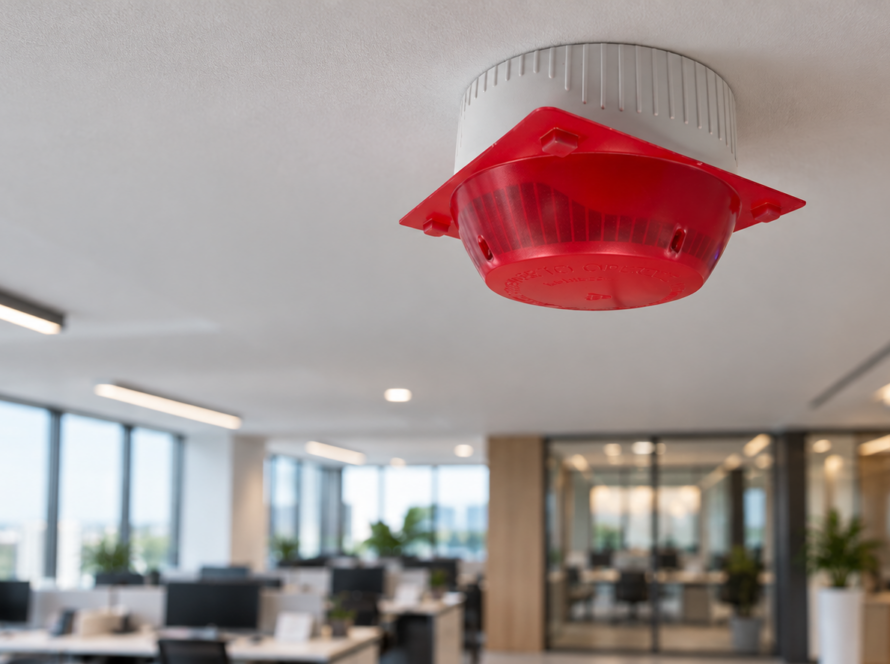
PIR detectors identify movement by monitoring changes in infrared energy, while microwave detectors analyse reflected microwave signals. Dual-technology detectors combine both methods, making them particularly useful in more demanding environments where greater resistance to unwanted alarms is needed.
The right motion detector depends on the protected environment, security risk, and expected activity. A PIR detector may be perfectly suitable for a stable office or home, while warehouses, high-value retail, or areas with changing temperatures may benefit from dual-technology detection.
PIR vs Microwave vs Dual Technology Detectors: Quick Comparison
FEATURE
PIR
MW
Dual-tech
Detection
Monitors changes in infrared energy
Measures changes in reflected microwave signals
Analyses both infrared and microwave activity
Best for
Homes, offices, shops, corridors
Selected large or challenging indoor areas
Banks, high-value retail, warehouses, technical rooms
Main Strength
Practical and efficient for stable indoor environments
Detects movement independently of body-to-room temperature contrast
Uses two technologies to improve detection confidence
Main Limitation
Affected by heat sources and low temperature contrast
Poor adjustment might lead to false alarms
Higher cost and more detailed configuration
Availability
Very common
Comparatively uncommon as a standalone detector
Common in higher-risk and challenging applications
How Does a PIR Detector Work?
A passive infrared detector monitors infrared energy naturally emitted by people and other warm objects. Its lens divides the protected area into detection zones. When a person moves across these zones, the detector recognises the resulting change in infrared energy.
PIR detectors are widely used because they are practical, cost-effective, and suitable for many stable indoor environments.
Typical Applications for PIR Detectors
PIR detectors are often suitable for:
- Homes and apartments
- Small and medium-sized offices
- Meeting rooms and corridors
- Retail units and back offices
- Other stable indoor areas with low or moderate security risks
For example, a PIR detector installed in the corner of a small office can monitor the entrance and the main circulation area after the premises have been armed. When someone crosses several detection zones, the change in infrared energy can be identified as movement.
PIR detectors can also be suitable in homes with pets when an appropriate pet-immune model is selected and installed correctly. Pet immunity is not simply an on-or-off guarantee. The animal’s weight, movement, furniture, mounting height, sensitivity settings, and room layout all affect performance.
Disdvantages of PIR Detectors
PIR detection relies on a temperature difference between the moving person and the surrounding environment. When room temperature approaches body temperature, this contrast becomes smaller and detection can become more challenging.
Direct sunlight, heaters, rapid temperature changes, and unsuitable positioning may also affect performance.
For stable indoor areas these limitations are usually manageable, but more demanding environments may benefit from another sensing technology.

How Does Microwave Detection Work, and Why Is It Rarely Used Alone?
A microwave detector emits low-power microwave signals and analyses how they are reflected by objects in the protected area. Movement changes the reflected signal, allowing the detector to recognise activity.
Unlike PIR detection, microwave sensing does not rely on thermal contrast. It can therefore remain responsive when ambient temperatures are close to body temperature.
However, microwave-only intruder detectors are comparatively uncommon. Microwave sensing is much more frequently used as one channel within a dual-technology detector.
Typical Applications for Microwave-Only Detectors
Standalone microwave detection may be considered in specialised indoor environments such as:
- Large, controlled indoor spaces
- Areas with significant temperature variation
- Locations where low thermal contrast may affect PIR detection
- Spaces where the microwave detection field can be clearly contained
For example, a microwave detector could be considered in an isolated, unheated storage area where temperatures vary considerably and there is little movement outside the protected space.
Limitations of Microwave-Only Detectors
Microwave signals can pass through glass and some lightweight partitions. If the range is set too high, movement in a corridor, neighbouring room, or outside the premises could affect the detector.
Metal surfaces can also reflect the microwave field, while machinery, vibration, fans, and other moving objects may contribute to unwanted activations.
These limitations are one reason microwave sensing is more commonly combined with PIR technology rather than used alone.

How Does a Combined PIR and Microwave Detector Work?
A dual-technology detector includes both PIR and microwave sensing. Each channel monitors movement independently, while the selected operating logic determines when an alarm is generated.
In AND mode, both channels must detect movement before an alarm is confirmed. This helps filter disturbances that affect only one technology. A temperature change, for example, may influence the PIR channel without producing a corresponding microwave detection.
Some detectors also provide OR mode, where either channel can trigger an alarm, or other operating modes that require a defined sequence of activations.
Typical Applications for Dual-Technology Detectors
PIR and microwave detectors are particularly useful in areas where environmental conditions are less predictable or where a higher level of security is required, including:
- Warehouses and large storage areas
- Banks and financial premises
- Jewellery stores and high-value retail
- Technical and equipment rooms
- Commercial buildings with changing temperatures
- Areas where reducing unwanted alarms is particularly important
For example, a warehouse may experience significant temperature changes throughout the year, reducing the temperature contrast available to a PIR detector. At the same time, relying only on microwave detection could introduce unwanted responses from activity outside the protected area. A properly configured dual-technology detector uses both channels to provide additional confirmation before generating an alarm.
Limitations of Dual-Technology Detectors
Dual-technology detectors are generally more expensive than standard PIR models and require more careful setup.
The microwave range must remain within the intended protected area, while PIR sensitivity and operating mode must also match the environment.
For a normal office, home, or small shop, a properly selected PIR detector may still be the more practical solution.

How Do You Choose the Right Intruder Detector?
The best detector depends on the premises rather than one technology being universally better.
Consider these five questions:
For a normal home, office, or retail room, a PIR detector is often sufficient. Areas with significant temperature variation may benefit from dual-technology detection.
Choose a detector with appropriate pet immunity and follow its installation requirements. Animal size, furniture, mounting height, and sensitivity all matter.
Standard PIR detection may be suitable for lower-risk areas. Banks, jewellery stores, high-value storage, and other sensitive premises may require dual-technology or anti-masking protection.
Dual-technology detectors operating in AND mode can provide additional confirmation before generating an alarm.
Detection technology and communication method are separate choices. PIR detection is available in both wired and wireless systems, allowing the solution to match the installation requirements.
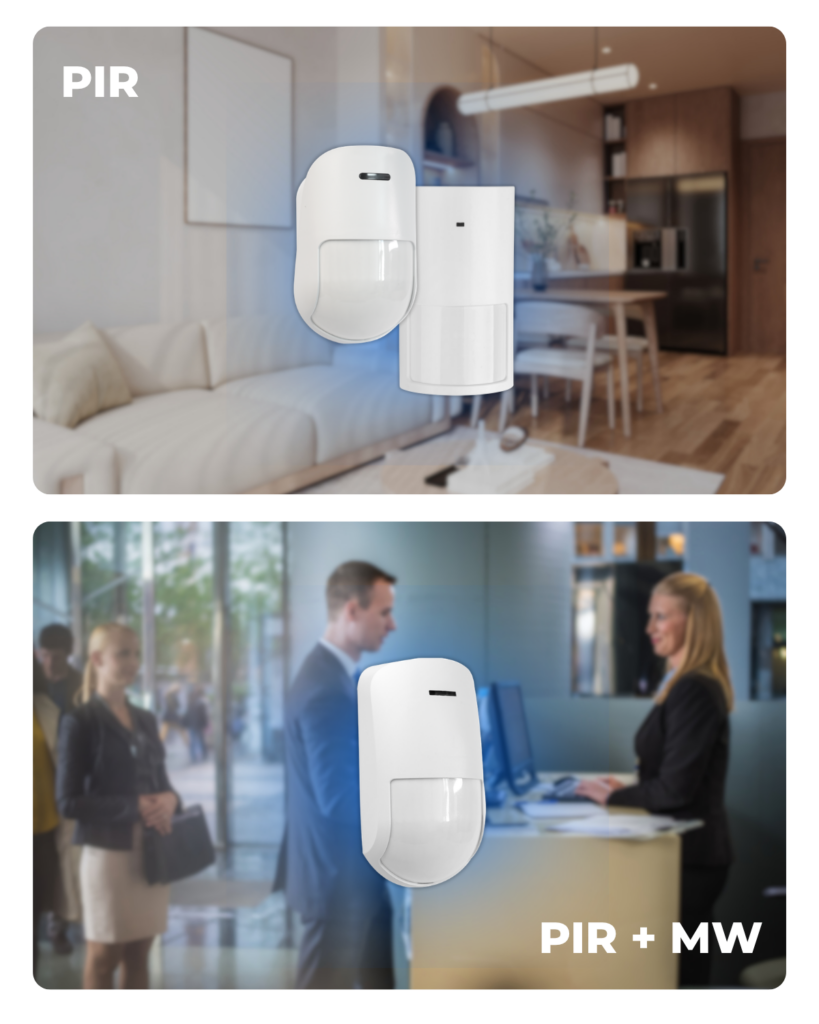
PIRIN DL provides wired PIR detection with selectable sensitivity, temperature compensation, creep-zone protection, and pet immunity. For more demanding applications, PIRIN MW combines PIR and microwave sensing with adjustable sensitivity and selectable operating modes. PIRIN MW/AM adds anti-masking and anti-spray protection for higher-risk premises.
For wireless installations, the PAX range includes PIR motion detection with features such as adjustable pulse filtering, automatic temperature compensation, pet immunity, and bidirectional communication.
PAX devices can be used with EMA, Teletek’s wireless intruder alarm system, or within hybrid installations through compatible expanders and panels. This gives installers flexibility when new cabling is difficult, unnecessary, or undesirable.
This broad portfolio allows designers and installers to choose the right detection technology for each area of a project, while relying on products certified to the relevant EN 54 standards.
Not sure which solution is right for your project?
Contact our team to discuss the environment, security level, and installation requirements.