Fire safety in museums must protect visitors and staff while also limiting damage to valuable collections and, in many cases, the historic building itself. Effective protection depends on early detection, carefully planned evacuation, suitable coverage for galleries and storage areas, and installation methods that respect sensitive interiors.
Museums present a unique fire safety challenge. A single building may combine crowded public galleries, valuable collections, archives, conservation workshops, technical rooms, and historic interiors where installing new equipment is difficult.
The goal is therefore not only to detect a fire, but to do so early enough to protect people and reduce the risk of irreversible damage.
How Do Fire Safety Needs Change Across a Museum?
Different museum areas can require very different approaches.
AREA
TYPICAL CHALLENGEs
FIRE SAFETY CONSIDERATIONS
Exhibition galleries
Valuable objects, changing layouts
Early detection, discreet devices, clear evacuation
Archives and storage
Dense combustible materials, limited occupancy
Early warning and protection around shelving
Historic interiors
Restrictions on drilling and visible cabling
Wireless or hybrid solutions with minimal intervention
Large halls and atriums
High ceilings and large air volumes
Beam, aspirating, or other suitable detection
How Should Large Galleries and Exhibition Spaces Be Protected?
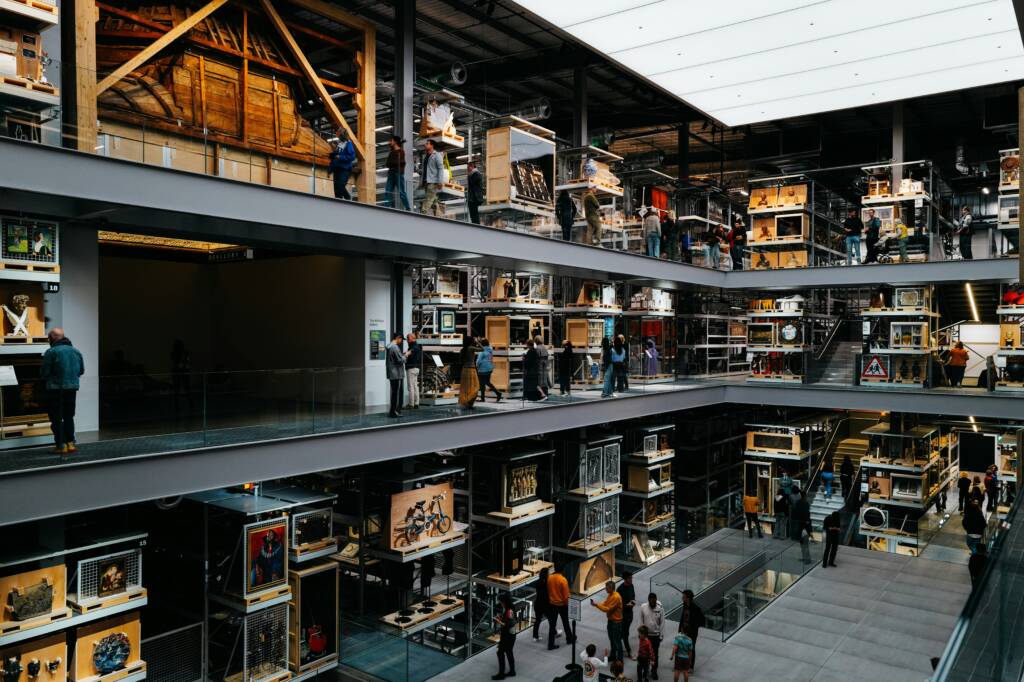
Large galleries can create particular detection challenges. In a high exhibition hall, smoke has farther to travel and may be affected by ventilation or the shape of the space.
Where conditions are suitable, optical beam detection can provide effective coverage across large open areas. The SensoIRIS BM60 and BM120, for example, cover distances of 5–60 m and 50–120 m respectively and can be useful in high galleries or atriums where the optical path remains clear.
However, beam detectors aren’t a “set it and forget it” solution. Just like other fire alarm detectors, they are set up to work under certain conditions. If those conditions change, and that isn’t addressed, they can start causing false alarms.
This is also why keeping exhibition changes in mind matters. New partitions, suspended installations, or large displays can obstruct detection paths or alter how smoke moves through a gallery. Let’s say that one hall is typically used to display medieval armory, but is then appropriated to temporarily host an exhibition of dinosaurs. Some of them can reach up quite a few metres from the floor, while others hang from the ceiling. Thus, problems start to arise, as the beam of the detector is obstructed. Fire alarm coverage should therefore be reconsidered when the layout changes significantly, and adjustments need to be done in time.

Why Are Archives and Collection Storage Areas Important in Fire Safety?
Visitors may spend most of their time in the galleries, but storage areas often contain the greatest concentration of valuable material.
An archive with densely packed shelves of documents, textiles, photographs, or historical objects may also remain unoccupied for long periods. A developing fire could therefore go unnoticed without automatic detection.
The protection strategy should consider both the value and combustibility of the stored material, as well as the shelving arrangement and accessibility of the area.
Where automatic suppression is used, its impact on the collection must also be considered. A solution appropriate for one type of collection may not be appropriate for another.
How Can Historic Museum Interiors Be Protected?
For museums inside protected buildings, installing the system can be almost as challenging as designing it.
Running new cables may require intervention in decorative walls, ceilings, or architectural features that should remain untouched. Wireless or hybrid systems can help reduce this impact by limiting the amount of new cabling required in sensitive areas.
We faced a similar challenge at the Holy Synod of the Bulgarian Orthodox Church, which, although not really a museum, is still a valuable historical building. There, we integrated over 300 Natron wireless devices with an iRIS4-based system. Wireless technology allowed us to provide the historical building with extensive protection, while reducing intervention.
Wireless design still requires careful planning. Thick masonry, metal structures, and unusual layouts can influence radio communication, so a proper site survey and signal testing remain essential.
How Should Visitors Be Evacuated?
Museum visitors usually do not know the building, which makes clear alarm notification and intuitive escape routes particularly important.
Large museums may contain several galleries, staircases, cafés, event spaces, and temporary exhibitions. Audible and visual alarm devices must therefore remain effective throughout the property, while voice evacuation can provide additional guidance in larger or more complex buildings.
Temporary exhibitions should also be reviewed from an evacuation perspective. New walls, installations, or display structures must not obstruct escape routes, manual call points, or alarm devices.
Staff training completes the strategy. Employees should know how to guide visitors and respond to an alarm, particularly in crowded galleries or areas with restricted access.
Frequently Asked Questions
Yes. New partitions, suspended displays, large showcases, or decorative structures can obstruct detectors, beam paths, manual call points, or alarm devices. Detection coverage and evacuation routes should be reviewed whenever an exhibition significantly changes the layout.
Often, yes. These spaces may remain unoccupied for long periods and can contain dense concentrations of paper, textiles, photographs, or other valuable materials. Detector selection should account for the stored materials, shelving arrangement, room conditions, and required speed of detection.
It can be particularly useful in larger or more complex museums where visitors may be unfamiliar with the building. Spoken instructions can provide clearer guidance than alarm tones alone, especially when different areas require different evacuation actions.